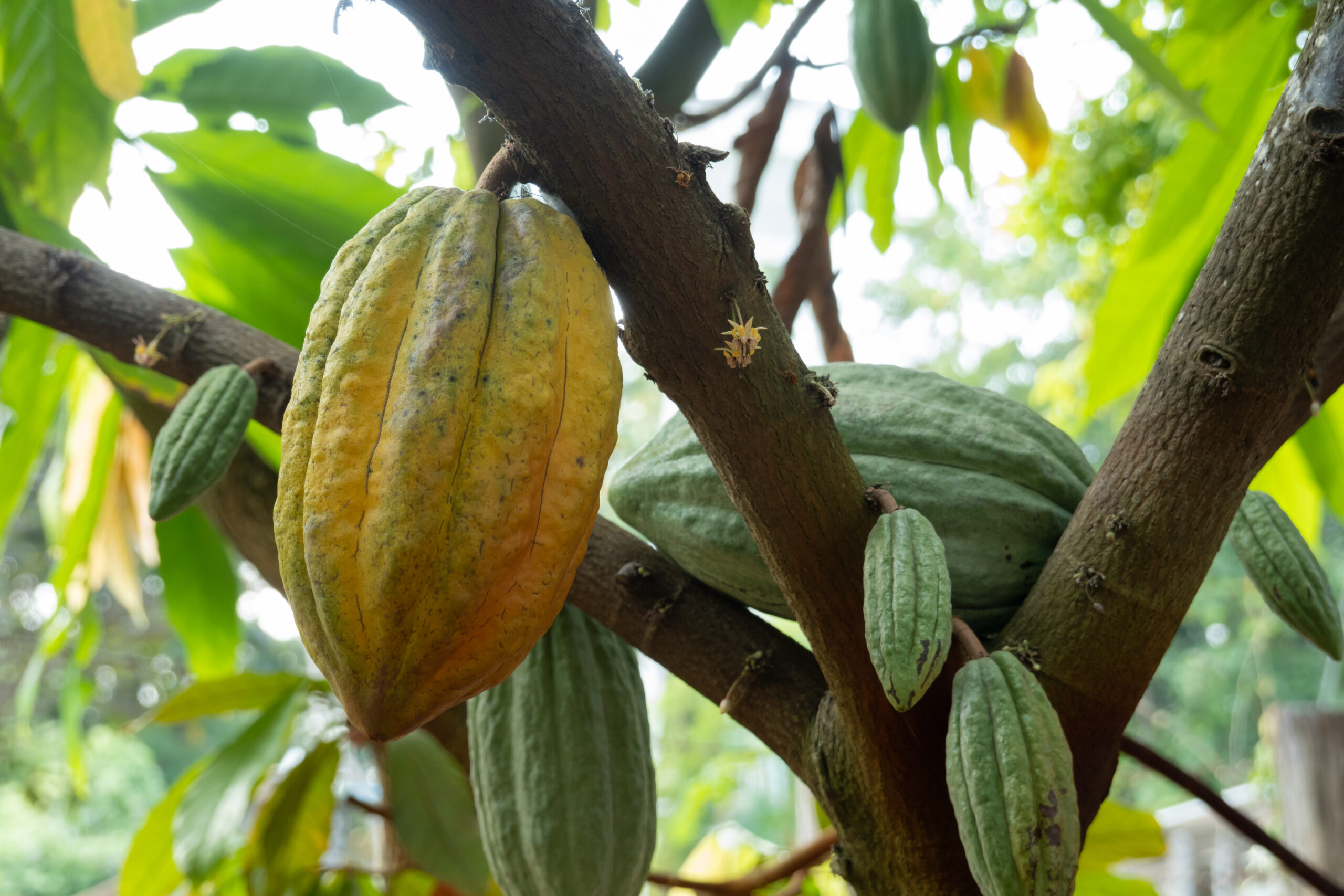
Most people do not think twice about where chocolate comes from. But behind every bar lies one of the world’s most traded crops, one that has been under serious strain for the past two years, and whose troubles have quietly changed what we find on store shelves.
It starts with the plant itself.
Cacao trees are fussy. They need steady heat, regular rain, and rich soil, and they only grow in a narrow tropical band around the equator. It takes several years before a new tree produces its first pods, and the trees are easily knocked back by drought or disease.
What makes this worse is that nearly all of the world’s cocoa comes from a very small part of the world. Côte d’Ivoire and Ghana together supply more than 60% of global production. A handful of other West African countries add a little more. Ecuador and parts of Asia contribute too, but far less. West Africa, in short, feeds the world’s chocolate habit, and that has always been a vulnerability waiting to be exposed.
It was exposed in 2024.
What went wrong
The crisis did not have a single cause. It was several problems hitting at once.
First, the weather. West Africa was hit by a run of droughts and heavy rains that damaged harvests in Côte d’Ivoire and Ghana in the same season. For an already delicate crop, this was a serious blow.
But the bad weather uncovered something deeper. A large share of West Africa’s cocoa trees is old, well past the age when they produce well or fight off disease effectively. Decades of too little replanting had left the region’s orchards weak and unable to handle any kind of shock. Fungal diseases tore through the weakened trees. Harvests collapsed.
The shortage hit global markets fast and hard. Chocolate makers who were used to steady supplies suddenly found themselves competing for whatever cocoa was available. Prices more than doubled within months, reaching levels not seen in decades.
Sooner or later, shoppers felt it.
What happened to your chocolate bar
When the cost of cocoa jumps fourfold, manufacturers do not have many options: raise prices, absorb the loss, or use less cocoa. Most did all three, just not always in ways you would notice.
Some prices went up visibly. But the bigger shifts often happened quietly. Recipes were tweaked to cut cocoa content without obviously changing the taste. Packages shrank while staying the same size, a trick the food industry calls “shrinkflation.” Some brands pushed products that relied less on cocoa, or smaller sizes where a price rise is easier to accept.
Taken together, these changes meant that people were eating less cocoa without really choosing to. Global cocoa consumption fell, not because people stopped liking chocolate, but because each product contained a little less of it. That drop in demand, alongside a partial recovery in harvests, helped bring prices back down from their peak.
For most shoppers, the crisis feels over. Chocolate is back on the shelves, and prices, while higher than a few years ago, are no longer climbing sharply. But the underlying picture is less comfortable than it looks.
Why the problem has not gone away
Most of what caused the 2024 crisis is still there.
The trees are still old. A big share of West Africa’s cocoa orchards remains aging, less productive, and more vulnerable to stress. Replanting takes time. A new cacao tree needs three to five years to produce properly, and during that wait, farmers have costs but no new income from those trees.
The climate is getting harder. Cacao needs stable conditions, and stable is exactly what it is not getting. Droughts, unpredictable rainfall, and rising temperatures are hitting growing regions more and more often. Some forecasts suggest the land suitable for cacao farming in West Africa could shrink significantly over the coming decades.
Farmers are squeezed. Most of the world’s cocoa is grown by smallholders with just a few acres of land, little access to loans, and not much money to invest. When incomes are too low, basic upkeep such as fertilizer, replanting, and disease management simply does not happen. This is both a human problem and a practical one, and the industry knows it.
What is being done
Over the past decade, cocoa traders, chocolate companies, farmer cooperatives, and aid organizations have been working together on practical solutions.
On the ground, that means helping farmers get hold of fertilizers, better seedlings, and training, things that are often out of reach when you are farming a few acres alone. In some areas, farmer groups pre-finance fertilizers and let members pay back through future cocoa sales, so cash flow is not a barrier. Replanting programs hand out young, disease-resistant trees alongside shade trees, so orchards can be renewed gradually without cutting off farmers’ income overnight.
The logic is simple: farms that get proper support produce more reliably, and that is good for everyone in the chain.
What it means for you
Chocolate with a high cocoa content will probably stay pricier than it was before 2024. The market will stay sensitive to weather and growing conditions, and a bad season somewhere in West Africa can still move prices quickly.
Cocoa is a crop under pressure. But it is also one that a lot of people are now working hard to protect.