That cup of coffee already crossed a chokepoint
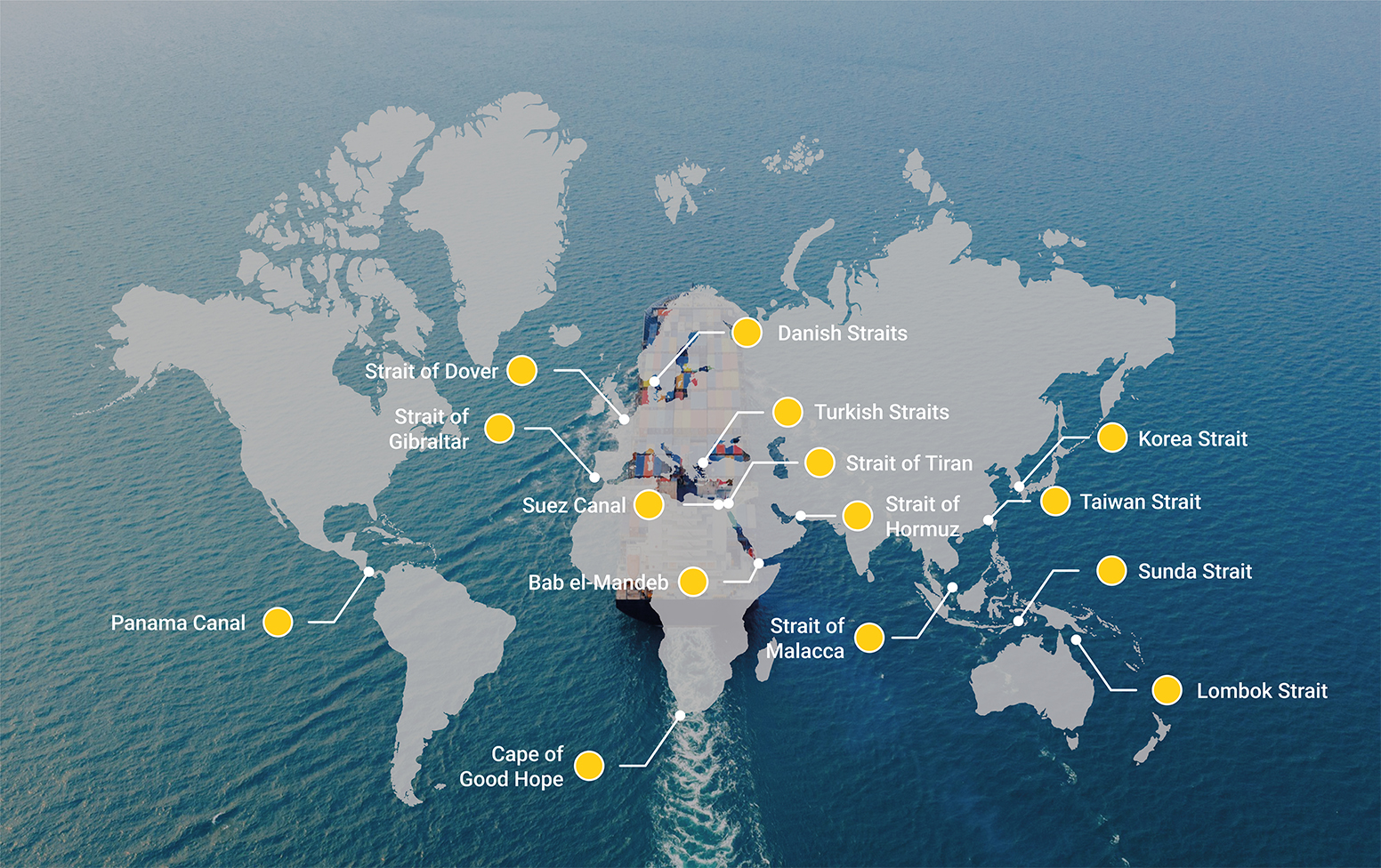
Pick up a cup of coffee. The beans probably grew in Brazil or Ethiopia, and the ship carrying them almost certainly passed through the Suez Canal before docking in Rotterdam or Los Angeles. Now think about the fuel in your car: a fifth of the world’s oil supply moves through a single narrow strip of water between Iran and Oman. The chip inside your phone passed through the Strait of Malacca. The wheat in your bread likely crossed the Turkish Straits out of the Black Sea. You have never seen these places, but they shaped nearly every object around you. Fourteen stretches of water, some barely wider than a city, quietly decide what the world pays for the things it needs.
What exactly is a chokepoint?
A maritime chokepoint is a narrow passage where shipping traffic from a much larger ocean or sea is squeezed through a tight corridor. Think of it like a highway that suddenly narrows to a single lane. Every truck still needs to get through. Anything that blocks the lane, an accident, a closure, bad weather, stops everything behind it.
On the open ocean, ships can reroute around almost any problem. At a chokepoint, they cannot. The geography forces every vessel to use the same narrow path. That concentration of traffic is what makes these passages so important and so fragile. A single grounded ship can block a canal entirely. A decision by a country controlling the adjacent land to restrict passage can redirect global trade overnight. The narrowness that makes these routes efficient also makes them vulnerable.
Why commodities depend on narrow water
According to UNCTAD, roughly 90% of traded goods travel by sea. Those goods: oil, liquefied natural gas (LNG, which is natural gas cooled into liquid form for shipping), grain, coal, iron ore, copper move on routes set by where they are produced and where they are consumed. Those routes almost always pass through at least one chokepoint.
Oil from the Persian Gulf goes through the Strait of Hormuz. Grain from Ukraine exits the Black Sea through the Turkish Straits. Manufactured goods from China reach Europe through Malacca and then the Suez Canal. LNG from Qatar crosses the Indian Ocean and splits, some going west through Bab-el-Mandeb, some east through Malacca.
Remove any one of these passages and supply chains do not pause, they reroute, at enormous cost and delay. Chokepoints are not just geography. They are the architecture of global trade
What happens when one closes
A closure triggers a chain reaction across markets, prices, and logistics.
Ships reroute first. A vessel that would have taken 12 days from the Red Sea to Northern Europe via Suez might now take 26 days around Africa. Those extra two weeks mean the ship is unavailable for its next cargo. Multiply that across hundreds of vessels and the effective global fleet shrinks.
Freight rates: the price shipping companies charge per container or per ton, then spike. When capacity falls, rates rise, and those costs pass through the chain: importers pay more, retailers pay more, consumers pay more. Commodity prices follow: oil that would have arrived in two weeks now arrives in four. Insurance premiums for vessels in the affected zone also rise.
The UNCTAD Review of Maritime Transport tracks how freight rate shocks in one corridor transmit across interconnected networks. Prices in landlocked supermarkets can move because a narrow strip of water on the other side of the world became harder to cross.
Why traders watch these passages every day
Commodity traders watch more than supply and demand for the raw material itself, they watch the entire logistics chain connecting producers to buyers. Chokepoints are where that chain is most exposed.
A disruption signal, a rumor, a weather warning, a political announcement can move freight rates within hours. Rates determine what traders call the “delivered price”: the all-in cost of getting a commodity from producer to buyer. The ISM notes that $3.5 trillion of global trade transits the Strait of Malacca annually, a figure that shows how much value sits exposed at a single passage.
Traders also build in risk premiums, a small extra margin reflecting the probability a route becomes harder to use. According to the EIA, chokepoint flows directly influence the benchmarks that set global oil prices. The geography of these narrow passages is embedded in what you pay at the pump and on every shelf.
Explore the full series
Each article in this series focuses on a specific maritime chokepoint. It traces its history, explains its importance to global trade, highlights the key commodities that pass through it, and examines how disruptions can affect supply chains around the world.